
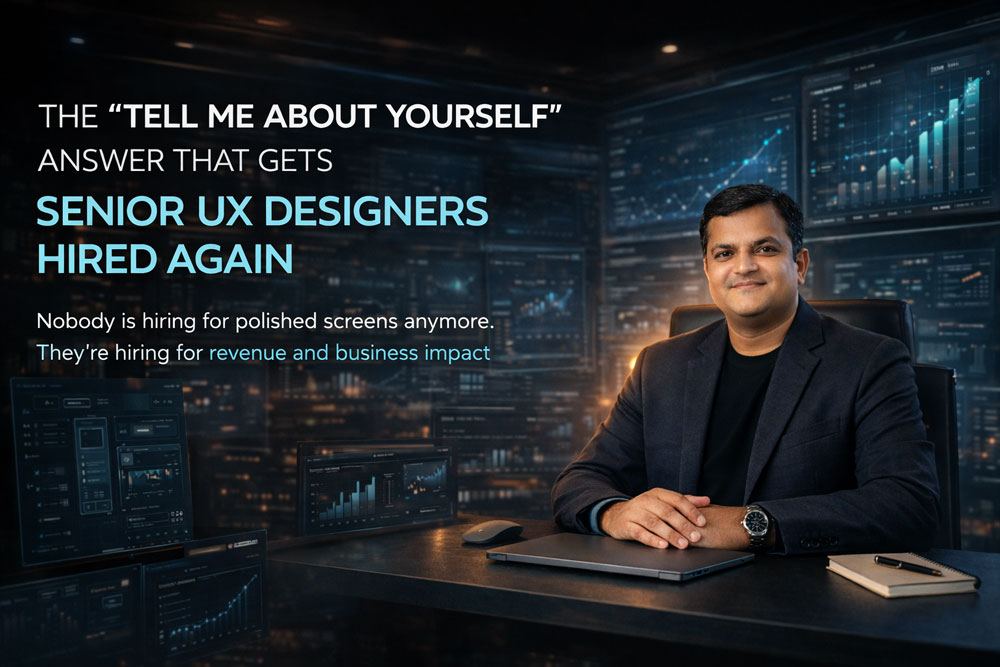
The perfect “Tell me about yourself” answer for a senior UX role does not list your design tools or basic process. It immediately positions you as a business problem-solver. Structure your answer in three parts: your executive UX identity, the specific business friction you remove, and the hard metrics you have delivered (revenue, retention, or reduced support costs).
In 2026, nobody is hiring senior UX professionals for polished screens alone. They are hiring people who can reduce friction, influence product direction, and connect UX to revenue, retention, and trust – and your first 30 seconds must prove that.
If you are a laid-off senior designer staring down an empty inbox, wondering why you have an experienced ux no job offer sitting on your desk despite your 5+ years in the trenches, we need to talk.
The market has shifted. Companies do not want order-takers. They want strategic partners. Getting a premium ux job today means your interview cannot sound like a junior portfolio review.
Let’s fix the way you introduce yourself, build a narrative that demands respect, and get you back to work.
Why Your Current Answer is Costing You Offers
Most senior designers start their interviews like this: “Hi, I’m [Name]. I’ve been a UX designer for 6 years. I specialize in end-to-end design, working with Figma, doing user research, and handing off to developers.”
Stop right there.
That answer is generic. It sounds like every other candidate in the pipeline. It focuses on output, not outcomes. The harsh truth is this: Your case studies lack outcomes and accountability. If your introduction doesn’t immediately signal business value, the hiring manager checks out before you even open your slide deck.
At the senior level, I don’t care how well you organize your Figma layers. I care about how you diagnose complex friction points. I care about how your design decisions impact my bottom line.
The Executive UX Introduction Framework
To command an executive-grade salary, you must speak an executive-grade language. You need to frame your experience around business impact.
Here is the exact framework to structure your “Tell me about yourself” answer. Make it a 60-to-90-second elevator pitch that covers these three bases:
- The Strategic Identity Do not call yourself just a “UX Designer.” Call yourself what you actually do for the business. Example: “I am a UX Architect focused on driving enterprise conversion and reducing customer churn.”
- The Problem-Solving Focus Tell them what kind of mess you are best at cleaning up. Example: “For the last five years, I’ve specialized in taking legacy SaaS platforms and untangling their workflows to reduce support ticket loads and improve user retention.”
- The Proof (The ROI) Hit them with a hard metric immediately. Example: “Most recently, my heuristic evaluation and redesign of a core checkout flow increased conversion by 14%, directly adding $1.2M in annual recurring revenue.”
The Teardown: Before and After
Let’s look at a real-world teardown.
The Fluffed Answer (What you are probably doing): “I’ve been at Company X for five years. I led the redesign of the mobile app. I ran usability tests, created personas, and worked closely with product managers to make the app look modern and user-friendly.”
The Executive Answer (What gets you hired): “Over the last five years at Company X, my core focus has been aligning user behavior with our revenue goals. I recently led the mobile app redesign. We realized our onboarding was too complex, causing a 40% drop-off. By conducting rigorous friction analysis and streamlining the architecture, we recovered 25% of those lost users, which translated to a significant boost in Q3 retention. I’m here because I want to bring that same level of conversion-focused UX to your upcoming product launch.”
See the difference? One talks about “making things look pretty.” The other talks about saving money, making money, and managing risk.
The Hiring Manager’s Scorecard
When you are talking, the person across the table is mentally ticking off boxes. Here is the actual scorecard I use when hiring senior talent:
- Business Acumen: Do they understand how this company makes money?
- Friction Diagnosis: Can they identify where users abandon a flow and explain why?
- Trade-off Mentality: Can they balance an ideal user experience with technical constraints and strict business deadlines?
- Cross-functional Influence: Can they push back on a bad product requirement using data, without being defensive?
If your opening answer hits these notes, you completely change the dynamic of the interview. You are no longer just a candidate begging for a job. You are a consultant offering a solution.
How to Master the “Trade-Off” Conversation
The quickest way to prove you are a true senior is to talk about trade-offs. Juniors want everything perfect. Seniors know that shipped is better than perfect, provided the core friction is removed.
In your introduction, or right after, drop a hint that you understand business constraints. Say something like: “I pride myself on finding the balance between a flawless usability standard and the reality of tight engineering sprints. I build scalable solutions, not just ideal states.” This creates instant dwell time in the interviewer’s mind. They will pause and think, “Finally, someone who gets it.”
The Unfair Advantage: UXGen Mastery
Look, knowing what to say is step one. Having the deep, analytical mindset to back it up when the technical questions start is step two.
This is exactly why I founded UXGen Academy. After 25+ years in this industry-diagnosing platforms, consulting for enterprise clients, and hiring hundreds of designers-I saw a massive gap. Training programs teach you how to draw rectangles. They don’t teach you how to survive a boardroom.
If you are a career switcher, or a laid-off senior struggling with your re-entry plan and interview readiness, you need a different level of training.
Our AI Driven UX Mastery program is not a generic bootcamp. It is a highly strategic, job-oriented curriculum built around business impact. In this premium live training, I deploy my total experience as a researcher and hiring geek to help you figure out your best career solution. We don’t teach fluff. We teach you how to diagnose complex systems, run rigorous UX audits, and leverage AI to speed up your workflow so you can focus on strategy.
It is designed to turn you into an executive-grade UX partner. Quality, trust, and decision clarity-that is what we build.
Next Steps for Your Re-Entry Plan
Stop sending out the same resume with the same empty case studies. Change your narrative today. Frame your past work around the friction you removed and the value you created.
Want to see exactly how your current case studies measure up?
Download my free Senior UX ROI Teardown Checklist (PDF).
This is the exact rubric I use to audit portfolios for my premium elite leads. It will show you exactly where you are losing hiring managers and how to inject business metrics into your work immediately.
Frequently Asked Questions
- How do I answer “Tell me about yourself” if my previous company didn’t track UX metrics?
Focus on the friction you removed. Even if you don’t have hard revenue numbers, you can quantify your impact by talking about reduced steps in a workflow, faster task completion times, or qualitative improvements in user trust and support complaints. - Why am I an experienced UX designer with no job offers?
The most common reason is that your portfolio and interview answers focus too much on design output (wireframes, tools) and not enough on business outcomes (revenue, retention, conversion). Senior roles require strategic thinkers, not just pixel pushers.
- How long should my “Tell me about yourself” answer be for a UX interview?
Keep it between 60 and 90 seconds. It should act as an elevator pitch. Give them the highlights of your strategic value, plant a few hooks about your achievements, and let them ask follow-up questions.
- What does an executive-grade UX portfolio look like?
An executive-grade portfolio treats the case study like a business case. It clearly states the business problem, the metrics at risk, the rigorous heuristic evaluation you conducted, the trade-offs you navigated with engineering, and the final ROI of your design decisions.
- How can AI help me land a senior UX job?
AI is a workflow accelerator. In our AI Driven UX Mastery course, we teach designers how to use generative AI to analyze user research faster, generate varied architectural models, and draft complex usability reports. Showing a hiring manager that you leverage AI to focus more on high-level strategy makes you a highly attractive, forward-thinking candidate.


