
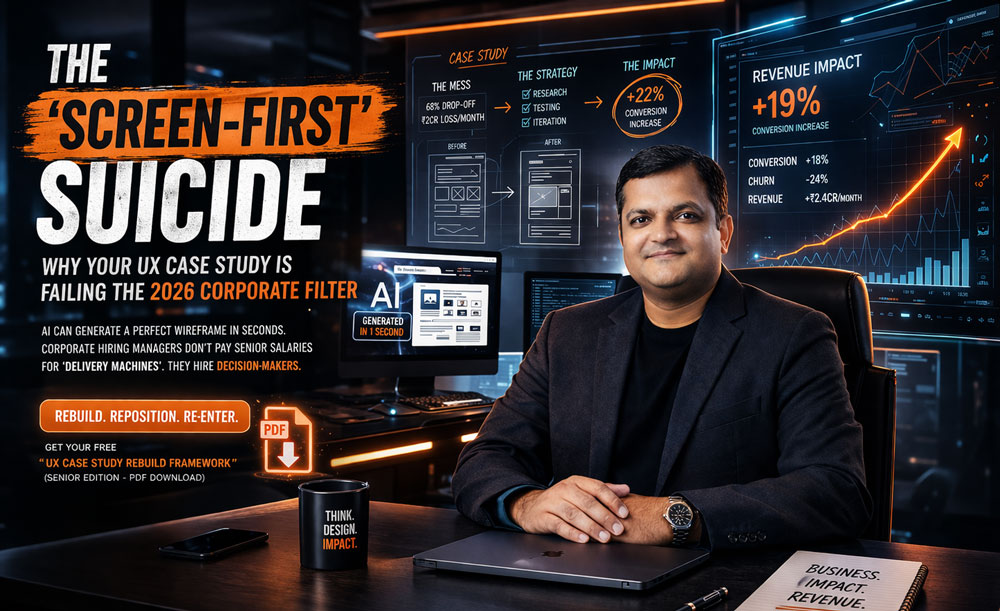
If your UX case study starts with UI screens, you have already lost the interview. In 2026, AI can generate perfect design outputs in seconds. Companies are no longer hiring screen-makers; they are paying premium salaries for strategic decision-makers who can untangle business chaos.
The Silent Mistake Killing Your Interview Chances
Let me say this directly.
If your portfolio case study opens with a polished UI, a beautiful hero image, or a clean dashboard, you have already failed the corporate filter.
In 2026, AI can generate wireframes, layouts, and full UI flows in exactly one second. Hiring managers at enterprise and SaaS companies are not impressed by screens anymore. When they look at your portfolio, they are asking one brutal question: “Can this person think, or do they just design?”
This is exactly why senior designers are struggling to land a UX job. The market is flooded with the exact same complaint: an experienced ux no job offer scenario. Layoffs feel harder to recover from because the rules of the game have fundamentally changed.
The core issue? Your case studies lack outcomes and accountability.
The 2026 UX Value Matrix: Screen-Maker vs. Decision-Maker
Let’s make the paradigm shift visually clear. Here is exactly how hiring managers categorize you within the first two minutes of scanning your portfolio:
| The Assessment | The “Screen-Maker” (Rejected) | The Executive UX Partner (Hired) |
|---|---|---|
| Primary Focus | Polished UI screens, color palettes, and Figma layouts. | Measurable friction reduction, conversion, and business ROI. |
| Case Study Hook | “We redesigned the app for a modern look.” | “We stopped a 64% checkout drop-off, capturing $200k in leaked revenue.” |
| Handling the Process | Shows generic sticky notes and standard Double-Diamond steps. | Highlights engineering constraints, budget limits, and messy trade-offs. |
| Metrics Tracked | “Usability improved,” or “Users found it delightful.” | Churn reduction, Tier-1 support ticket decrease, trial adoption rates. |
| AI Integration | Threatened by AI layout and wireframing generators. | Uses AI to accelerate execution to focus purely on high-level strategy. |
What Actually Happens When a Hiring Manager Opens Your Portfolio
Forget what you think matters. They don’t scroll slowly to admire your typography. They scan. They are hunting for four specific signals:
- The Business Context: They want to know what was financially broken and what was at risk for the company. If this context is missing, you are out.
- Decision-Making Depth: They look for the tough trade-offs you had to make. What did you actively reject, and why? If your case study looks like a “perfect” linear journey, it feels fake.
- Measurable Impact: Did user drop-offs reduce? Did revenue increase? If you don’t show numbers—even projected ones—there is zero trust in your strategic ability.
- Ownership & Accountability: They need to know which decisions were strictly yours. If everything is framed as a generic “team effort,” you strip away your own leadership signal.
5 Actionable Pointers to Pass the Executive Filter
If you want to stop getting rejected, you need to restructure your portfolio immediately. Implement these five pointers to create instant dwell time and prove your executive worth:
- Pointer 1: Delete the Hero Image. Replace it with a one-sentence summary of the business problem and the final financial outcome. Hook them with stakes, not pixels.
- Pointer 2: Highlight Engineering Constraints. Executives don’t trust “perfect” case studies. Show the tech debt, the tight deadlines, and the messy reality you successfully navigated.
- Pointer 3: Translate UX into Revenue. If you improved an onboarding flow, estimate how much abandoned revenue that captured for the business. Speak their language.
- Pointer 4: Show What You Rejected. Highlighting the ideas you threw away proves you can make strategic, data-driven trade-offs under pressure.
- Pointer 5: Speak the Language of Risk. Explain how your usability testing prevented the company from launching a costly mistake or compliance nightmare.
Where UXGen Academy Fits Into This Shift
This is the uncomfortable truth: many experienced designers mastered tools and processes but never learned business thinking, funnel behavior, or revenue impact. AI simply exposed this gap.
At UXGen Academy, we do not train you to use UI tools. Most programs still focus on portfolio visuals and generic assignments. We focus on business-driven UX, layoff recovery, and interview readiness for senior roles.
We brought in Mentor Manoj because he is not just a trainer. With over 25 years of experience in the field, Manoj is a heavyweight UX Researcher and a hiring expert. He understands exactly why candidates get rejected and what enterprise hiring managers are actually looking for. In our UX Mastery Premium Live Training, his entire decades-long experience is deployed into your career rebuild. We teach you how to integrate AI workflows so you can focus on what actually gets you hired: solving real business problems.
Final Reality Check
Let’s not sugarcoat this. The problem isn’t just layoffs; the problem is your positioning.
If your identity is “I design screens,” you will continue to struggle.
If your identity is “I solve business problems using UX,” you will lead.
Ready to Re-Enter the Market with Authority?
If you’re stuck, if your interviews aren’t converting, or if you’re hearing dead silence after applying… start here.
Download the UX Case Study Rebuild Framework – Senior Edition (PDF)
Use this internal audit checklist to identify why your portfolio is failing, convert your UX work into measurable business impact, and crack managerial roles.
Frequently Asked Questions (FAQ)
Why am I not getting a UX job after layoffs?
Companies now prioritize business impact over design execution. If your case studies lack outcomes and accountability, you will not pass the initial hiring filter. Hiring managers are looking for risk-mitigators who understand the bottom line, not just pixel-pushers.
What is wrong with my current UX case study?
Most likely, it contains no metrics, no revenue impact, and no explanation of the difficult decisions you made. It probably focuses far too heavily on the final UI rather than the messy constraints and engineering pushback you had to navigate to get there.
Is AI replacing UX designers in 2026?
No. AI is replacing repetitive design tasks like wireframing and layout generation. Strategic, decision-making UX roles focused on research, usability analysis, and business alignment are actually becoming more valuable.
How should a UX case study start?
It should start with the business problem, the revenue risk, and the user friction. Do not start with UI screens. Hook the reader with the financial stakes of the project and why solving it mattered to the company.
How do I fix the “experienced ux no job offer” problem?
You must shift from tool-based thinking to business and strategy thinking. Rebuild your case studies to highlight measurable outcomes, constraints, and the direct ROI of your UX interventions. Position yourself as an executive partner who drives revenue and retention.


